


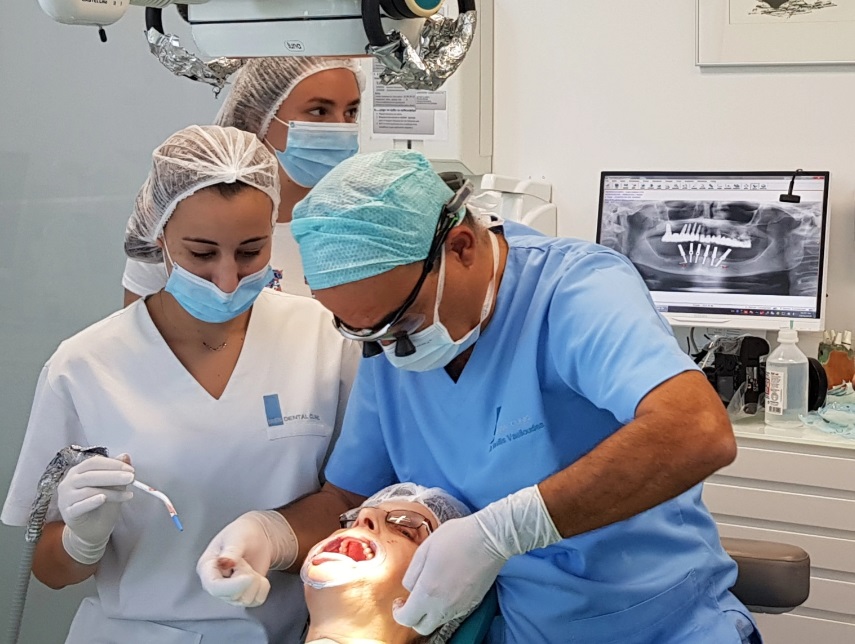
Safe & Pain-Free Dental Implant Placement in Nicosia, Cyprus
Dental implants are an ideal, advanced, safe, and popular solution to missing teeth. They look and function like natural teeth, enabling patients to speak, chew and smile with confidence!
They are suitable for patients of any age, as long as their oral health is satisfactory. The implant placement procedure is painless as the oral surgeon uses local anesthesia that does not affect the surrounding teeth. You can have your implants placed in the upper or lower jaw, providing a permanent, stable and durable foundation for a replacement tooth, such as a crown or a bridge.
Restore your smile, confidence, and oral health by reaching out to Smalto Dental Clinic for top-quality dental implant placement in Cyprus!

What Are Dental Implants?
A dental implant is a small, titanium post that is surgi]y placed into the jawbone to replace the root of a missing tooth. They have been around since 1980, yet modern dentistry has made them available for people of all ages and backgrounds.
Dental implants come in two parts: the first part replaces the tooth’s root through a small operation underneath the gums in the bone of the jaw. The second part involves the visible part in the mouth on which the tooth is placed.
Dental implants are a permanent and reliable solution for missing teeth, unlike dentures, which can slip or move around in the mouth.

Benefits of Dental Implants
Look and feel like natural teeth.
Improve people’s quality of life.
Prevent bone absorption after the loss of natural teeth.
Have the highest success rate compared to all other treatment options.
Can be used in all cases where removable prosthetic work would be needed.
Require no preparation for the placement of adjacent teeth.
Are suitable for people of all ages with good oral health.

How Are Implants Placed?
The implants are covered with the gums and remain in the jawbone for 2-3 months, to allow for the necessary bonding with the surrounding bone (osseointegration).
After the necessary waiting period, the implants are uncovered, and the next step of preparation for the prosthetic work begins. Meanwhile, the patient can use temporary bridges or dentures.

Is The Process Of Placing Dental Implants Painful?
The majority of patients who undergo dental implant placement state that the discomfort is much less than expected, while in the few cases where minor pain is observed, a simple painkiller is enough.
Note that every patient’s experience may vary as some may have a higher pain tolerance than others. Smalto’s dentists and oral surgeons can discuss any concerns you may have about dental implant placement and provide detailed information about what to expect.

Is The Process Of Placing Dental Implants Painful?
Clinical practice and related research have shown that this method has excellent results in terms of stability and aesthetics.
Our oral surgeons at Smalto Dental Clinic in Nicosia are experts in advanced implant placement techniques, including All–On-4 Prosthetic Rehabilitation in the lower jaw, where all teeth can be supported by 4-5 dental implants.

Bone Grafting – Sinus Lift
Bone grafting involves adding bone material to the area where the implant will be placed in order to provide additional support for the implant and improve the overall success of the procedure. This material can be obtained from the patient’s own body, a donor source, or a laboratory-created substance.
After the bone grafting procedure, the patient will need to allow time for the grafted bone material to fuse with the existing bone tissue. This typically takes several months before the implant can be placed.
While the additional step of bone grafting may prolong the overall treatment time for dental implant placement, it can significantly increase the chances of success for the implant and provide a lon

Do I Have To Place A Dental Implant For Every Tooth Lost?
In cases where extensive prosthetic work is required, there is no need to replace each lost tooth with an implant. Here are the most common prosthetic work options using dental implants:
Rehabilitation of a single tooth
Immovable porcelain bridge on two or more implants
Total mouth rehabilitation with bridges supported by dental implants
Τotal denture supported on cylindrical connections or metal bars

Am I Too Old For Dental Implants?
What is important is the general health and oral hygiene of the patient. As long as one’s overall health is good and the jawbone has sufficient density and volume to support the implant, he/she a good candidate for the procedure, regardless of age. In cases of patients who suffer from other health problems, dental implants can be placed following consultation with their doctor.
In those rare cases where no bonding is achieved between the bone and the implant, the implant is removed, the area is cleaned and, after a few weeks, a new implant is placed.
Many older adults have successfully undergone dental implant treatment at Smalto Dental Clinic with great results. Call our clinic in Nicosia today to learn more about dental implants!

What Is The Life Span Of Dental Implants?
Dental implants may not run the risk of tooth decay. However, they may be affected by peri-implantitis, which is the inflammation of the gums and the bone around the implant. Consequently, oral hygiene is of the utmost importance.
Daily brushing and flossing combined with regular dental checkups are vital, exactly as we do with natural teeth. Smoking, as well as too much pressure on implants as a result of bruxism (teeth grinding), can also reduce implant success.
However, research has shown that in the 30 years of using dental implants, the success rate of related prosthetic work is more than 90%, which makes them the most reliable choice of modern dentistry.
